

The Municipality of Neuquén is joining the campaign “10, 100, 1,000 Human Rights Cities and Territories by 2030” from an integral vision of local government based on participatory processes.
Under the governance of Mayor Mariano Gaido, Neuquén Capital has been consolidating an agenda of territorial proximity, modernization, expansion of public services, innovation, inclusion and citizen participation. In this framework, the Secretariat for Human Rights, Institutional Relations and International Cooperation, led by Dr. Luciana De Giovanetti, promotes a human rights approach that understands participation as a methodology of public management.
For Neuquén, human rights are not only a normative, commemorative or declarative agenda. They are a concrete way of governing the city: listening to demands, coordinating institutions, supporting community trajectories, preventing violations, promoting coexistence, ensuring accessibility, recognizing identities, strengthening democratic memory and bringing the State closer to people.
Local governments are essential to promote, respect and fulfill human rights because they are the level of government closest to people’s daily lives. Where people study, work, migrate, move around, participate, age, provide care, express their identity or experience situations of vulnerability, the municipality can generate concrete, accessible and territorialized responses.
Neuquén has a participatory structure made up of municipal councils, social organizations, public and private institutions, neighborhood commissions, migrant communities, diversity organizations, older persons’ centers, schools, clubs, libraries, provincial and national bodies, and territorial representatives. This structure makes it possible to transform social demands into concrete public policies.
From this perspective, the Secretariat promotes participatory processes related to children, adolescents, older persons, persons with disabilities, diversity, migrants, active memory, Malvinas, prevention of problematic consumption, non-discrimination, access to justice, democratic education, interculturality and territorial training.
Neuquén develops policies such as the Flag-waving for Democracy, the Identity Circuit, the Children’s Festival, the permanent Malvinas agenda, the Municipal Diversity Council, the Migrant Council, the Migrant Support Office, the Cultural Diversity Fair, territorial workshops on trades, theatre and expression, free legal clinics, the Local Survey on Discrimination, Embracing Rights, and the projection of MIGRANEUQUÉN as a tool for local migration governance.
In this sense, Neuquén Capital understands human rights as fundamental values and as a useful framework to guide local action, as they help organize priorities, build social legitimacy, strengthen democratic coexistence and design public policies focused on human dignity.
Joining this campaign represents an opportunity to recognize and internationalize an already existing local experience: a city that builds human rights from the territory, through participatory processes, institutional presence, active memory, public innovation and political commitment.
The Municipality of Neuquén wishes to join the campaign “10, 100, 1,000 Human Rights Cities and Territories by 2030” in order to strengthen and project a local policy based on participatory processes, inclusion, active memory, diversity, interculturality, democratic education and access to rights.
Joining the campaign will make it possible to give visibility to a municipal experience that is already underway and that brings together participatory councils, social organizations, public institutions, neighborhood commissions, schools, communities, migrant groups and State bodies. This methodology makes it possible to build public policies through listening, co-responsibility and territorial presence.
Neuquén understands that local governments play a fundamental role in making human rights effective in daily life. For this reason, joining the campaign seeks to share lessons learned, become part of a global network, strengthen international cooperation and reaffirm the city’s commitment to human dignity, justice, democratic coexistence and inclusion.
-
Participatory processes for local human rights governance
The Municipality of Neuquén develops a local human rights policy based on participatory processes, promoted by the Secretariat for Human Rights, Institutional Relations and International Cooperation, under the leadership of Dr. Luciana De Giovanetti, within the framework of Mayor Mariano Gaido’s governance.
This policy is expressed through a network of councils, roundtables, community spaces and institutional partnerships that bring together the municipal government, social organizations, public and private institutions, provincial and national bodies, neighborhood commissions, schools, communities and territorial representatives.
Among the main spaces are the Municipal Diversity Council, the Migrant Council, the Municipal Council of Older Persons, the Council for Children, Adolescents and Families, the Council of Persons with Disabilities and the Local Council for the Prevention of Problematic Consumption.
These processes make it possible to build shared agendas, listen to demands, organize activities, promote rules of coexistence, prevent rights violations and transform citizen participation into concrete public policies.
This policy shows that Neuquén does not conceive human rights as an isolated agenda, but as a form of local governance. Participation allows the community to be an active part of the design, implementation and sustainability of public policies.
Actors involved:
Municipality of Neuquén, Secretariat for Human Rights, Institutional Relations and International Cooperation, municipal undersecretariats, participatory councils, social organizations, neighborhood commissions, educational institutions, provincial and national bodies, communities, community representatives and civil society organizations.
Main progress achieved:
Consolidation of multiple participatory councils; coordination with territorial organizations and institutions; development of community, educational, cultural, sports and prevention activities; strengthening of a management methodology based on listening, participation and co-responsibility.
-
Democratic education, active memory and citizen identity
Neuquén Capital develops a sustained agenda of human rights education, democratic memory, citizen identity and sovereignty, especially aimed at children, adolescents, schools and the wider community.
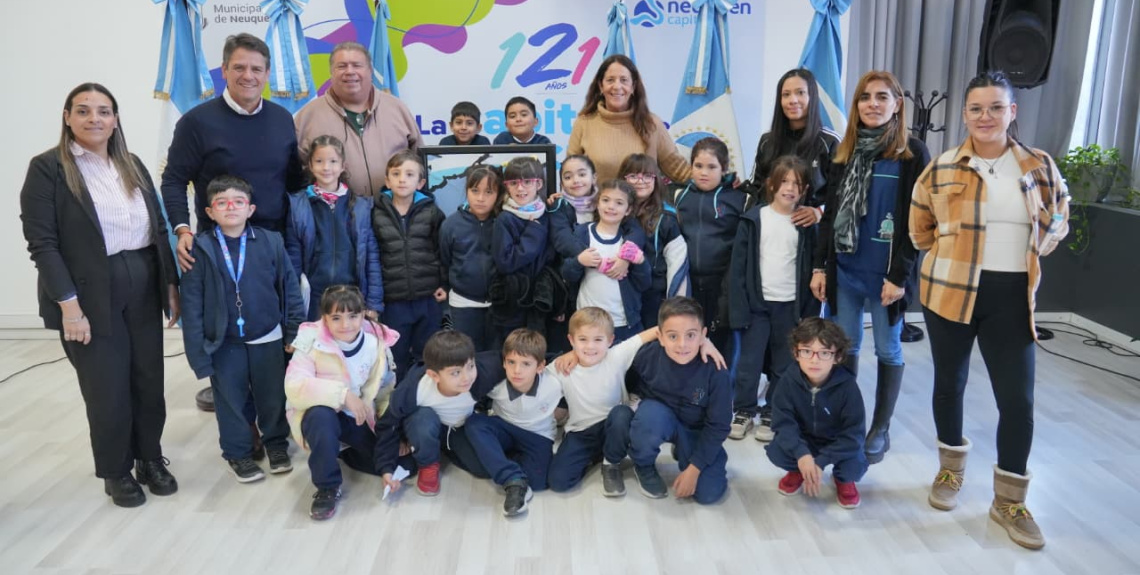
Among its main actions are the Flag-waving for Democracy, the Identity Circuit, the Children’s Festival, memory activities related to Malvinas, talks on non-discrimination and coexistence, and educational experiences such as Mayor for a Day, which allows children to learn how municipal government works.
The Flag-waving for Democracy has been held for four years around 30 October, a date linked to Argentina’s return to democracy in 1983. It works with 6th and 7th grade primary school students through preparatory workshops on democracy, coexistence, participation and human rights, and culminates in a large event on Isla 132 with the participation of thousands of students.
The Identity Circuit allows participants to visit key memory and human rights sites in the city, with interactive teaching materials for schools and coordination with the Undersecretariat of Tourism. This policy strengthens Neuquén’s identity as a city committed to active memory.
The Malvinas agenda is developed together with the War Veterans Centre, schools and community organizations. On the 2nd day of each month, a flag-raising ceremony and tribute to the 649 fallen soldiers is held. The municipality also supports the vigil on 1 April, the ceremony on 2 April, the carnation ceremony and the commemoration on 2 May of the sinking of the ARA General Belgrano, where local hero Tulio Esteban Lacroix died.
This policy transforms memory, democracy and human rights into educational, territorial and community experiences. Neuquén does not work on memory only as a commemorative date, but as a sustained public pedagogy throughout the year.
Actors involved:
Municipality of Neuquén, Secretariat for Human Rights, Provincial Education Council, primary schools, Undersecretariat of Tourism, War Veterans Centre, human rights organizations, child and adolescent affairs areas, teachers, students, families and the community.
Main progress achieved:
Four years of the Flag-waving for Democracy; annual participation of between 2,000 and 3,000 students; Children’s Festival implemented in eight schools; educational tours through the Identity Circuit; permanent Malvinas agenda every 2nd day of the month; screening of the documentary “Malvinas nos Une” as a cultural, educational and testimonial tool.
-
Territorial inclusion, cultural diversity and local migration governance
Neuquén Capital develops a policy of territorial inclusion, cultural diversity and local migration governance that integrates actions with migrants, diverse communities, people in vulnerable situations, neighborhood commissions and community organizations.
This policy includes the work of the Migrant Support Office, the Migrant Council, the Cultural Diversity Fair, the development of MIGRANEUQUÉN, the actions of the Municipal Diversity Council, territorial training workshops, free legal clinics and campaigns to prevent discrimination.
The Migrant Council connects the municipality with national and provincial bodies, the Red Cross, Pastoral Care for Migrants, consulates and migrant community leaders. This space helps address situations of vulnerability, documentation, access to rights, community integration and intercultural coexistence.
The Cultural Diversity Fair has become a policy of major citizen participation, with the presence of communities, gastronomy, typical products, dances, artistic shows, floats and cultural expressions. In its carnival edition, it gathered approximately 40,000 people, including groups from the city and other localities.
MIGRANEUQUÉN is projected as a platform for guidance, communication accessibility and a one-stop service point for migrants, refugees, newcomers and people in vulnerable situations. The initiative seeks to organize information on rights, procedures, services, competent bodies and care pathways, coordinating municipal areas such as Modernization, Communication, Citizen Service 147, the Migrant Support Office and external actors such as IOM/UN Migration, Pastoral Care for Migrants, the Red Cross and the Neuquén Police.
The policy is complemented by workshops on men’s hairdressing and barbering, sewing and sustainable design, theatre and expression, developed in neighborhood commissions, libraries and community spaces, with a human rights approach focused on labour inclusion, coexistence and training for people in vulnerable situations.
This policy shows how Neuquén transforms cultural diversity, migration and social inclusion into concrete public policies. The city recognizes migrant and diverse communities not only as beneficiaries of policies, but as protagonists of participatory processes.
Actors involved:
Municipality of Neuquén, Secretariat for Human Rights, Migrant Support Office, Migrant Council, Municipal Diversity Council, migrant communities, community leaders, Red Cross, Pastoral Care for Migrants, consulates, IOM/UN Migration, Neuquén Police, Modernization, Communication, Citizen Service 147, neighborhood commissions, LGBT organizations, entrepreneurs and the community.
Main progress achieved:
Consolidation of the Migrant Council as a broad space for coordination; sustained development of the Cultural Diversity Fair; participation of approximately 40,000 people in the carnival edition; support for communities in cultural activities and national anniversaries; projection of MIGRANEUQUÉN as a public innovation tool; development of territorial workshops with a human rights approach; free legal clinics for people in vulnerable situations; sports and community activities with diversity organizations.
MIGRANEUQUÉN Commitment: Link here
Active Platform: Link here