

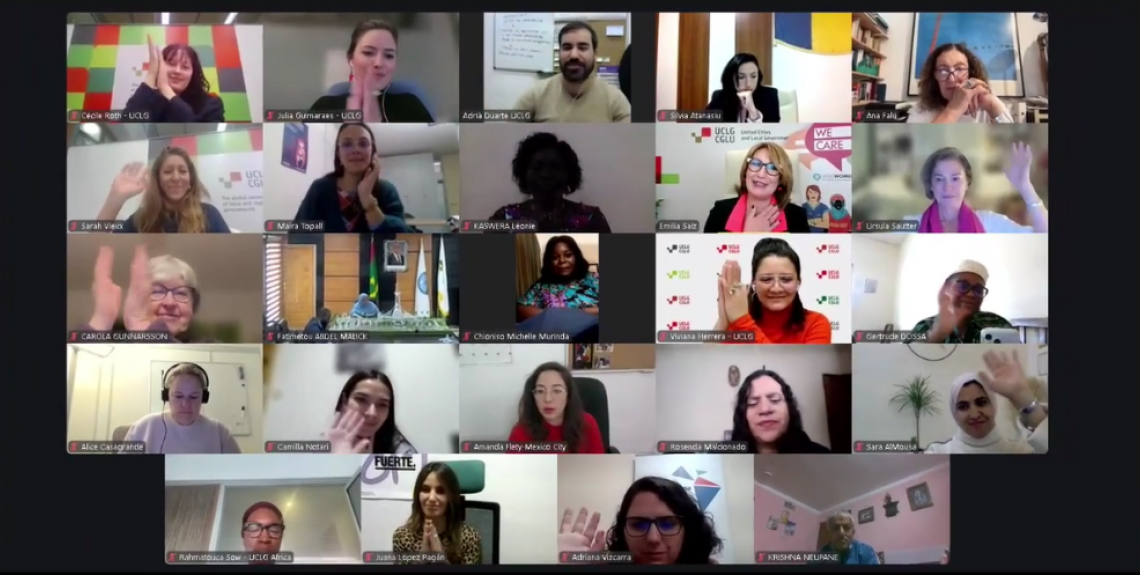
On November 26, more than 80 locally elected women, female leaders, and representatives of local and regional governments and international institutions gathered online for the global dialogue “Local and Territorial Voices of Power: Women’s Leadership to End Violence Against Women” Held in the framework of the International Day for the Elimination of Violence Against Women (25 November) and the 16 Days of Activism against Gender-Based Violence campaign led by UN Women, the event reaffirmed the critical role of local and regional governments in leading action and transformative responses to gender-based violence.
Led by our Committee, this session was organized by UCLG and the International Observatory on Violence Against Women (OIVF) of our co-presidency, the Departmental Council of the Seine-Saint-Denis, with support of the WYDE Women’s Leadership initiative, cofunded by the European Union and led by UN Women. The event marked one year since the closing seminar of the international program Towards Caring Territories for Women Victims of Violence, led by our Committee and the OIVF, and 30 years of the Beijing Declaration and Platform for Action. The dialogue contributed to identifying the priorities of our Feminist Municipal Movement ahead of key global milestones in 2026, such as the UN Commission on the Status of Women (CSW70) and the UCLG Congress, to be held in Tangier in June next year.
Local and Regional Government alliances leading change to shift social norms
Opening the session, Fatimetou Abdel Malick, President of the Nouakchott Region, Co-President of UCLG and Chair of the UCLG Standing Committee on Gender Equality, emphasized that women’s local leadership is helping reshape governance models, strengthening democracy, and build alliances:
“The leadership we exercise as locally elected women profoundly transforms the way power is practiced. It renews governance toward greater horizontality, equity, and shared responsibility. It revitalizes democracy.”
She underscored the importance of international cooperation—including the WYDE Women’s Leadership initiative funded by the European Union and the example of Seine-Saint-Denis’ Observatory—and highlighted two critical moments for 2026: the CSW70 and the UCLG World Congress in Tangier.
UCLG Secretary General Emilia Saiz reiterated that gender equality and fighting Violence Against Women (VAW) are key priorities in our agenda:
“Our organization has self-declared a feminist municipal movement.”
But she emphasized that achieving this common goal would not be possible without strong partnerships, bringing local action and international agendas together.
Alice Casagrande, Head of the OIVF, reiterated this belief with conviction, emphasizing the importance of international local partnerships, such as our joint program:
“We are convinced that this moment we are experiencing—a true backlash—is a critical time for strengthening partnerships at the local level. These avenues of cooperation give us air in a moment of blockage; they help us regain our footing and give us the momentum to move forward.”
Feminist Local Action Against Violence: Taking stock of one year of action since the Towards Caring Territories final seminar
Marking one year since the conclusion of the Towards Caring Territories program, the first panel—moderated by Maïra Topall, International Programs Coordinator at the OIVF, reflected on how local governments are transforming global commitments into concrete actions against VAW.
Pascale Labbé, Vice-President of the Seine-Saint-Denis Departmental Council, highlighted the importance of organized partnerships, like the one between UCLG - through our Commission - and her territory. She reminded the three main objectives of the Towards Caring Territories program:
-
To create observatories to fight violence against women throughout the world,
-
To contribute to articulating a global coalition of local governments committed to fighting violence against women
-
To raise awareness among the general public.
She stressed the importance of building local observatories, launching a global network of local governments working on ending violence against women, and expanding international peer-learning spaces: “This invites us to reflect on best practices, and the network allows us to refine our shared knowledge. The network continues to thrive through international forums, such as the Gwangju World Human Rights Cities Forum (WHRCF) and the “Reshaping Power for Equality” Internacional Conference, organized last September 2025 in Stockholm.
Rohey Malick Lowe, Mayor of Banjul and REFELA President, recalled the stark violence faced by women in Gambia: 3 out of 4 women have undergone female genital mutilation (FGM), despite its prohibition. The Mayor of Banjul emphasized that empowering women in local politics and ensuring their continued participation are essential for translating policy into real, effective protections:
“Women’s lasting participation is not negotiable. Every space we occupy, despite the threats, represents a victory against the silence in force. The local is where change becomes tangible.”
From Argentina, Mayra Mendoza, Mayor of Quilmes, described a political environment marked by institutional backlash, gendered persecution, and feminization of poverty, stressing that resistance is the key to fighting against patriarchal norms. But she also made a call for putting care at the heart of transformative action:
“Care is a form of power. We must deepen our political awareness—of our cities and of the meaning of care itself. Caring has the power to shift cultural norms, and it also offers a pathway to building political power.”
She pointed to actions being taken to address violence against women, ranging from setting up the Secretariat of Women, Diversity, and Human Rights to initiatives promoting women’s economic autonomy.
Nelly Ouassennan - Second Deputy Mayor of Cocody and Co-President of OIDP for Gender Equality - elaborated on the actions Cocody is taking to tackle VAW and the importance of prevention efforts and response services, stressing that awareness campaigns are key. Nevertheless, she called for the systematic mainstreaming of gender equality and rights in all policymaking.
Concrete mechanisms to combat violence against women remain costly. The examples from Cocody and Ziguinchor demonstrate that genuine political support is crucial—and with it, the necessary resources to continue saving lives.
“We saved the lives of 35 women through our emergency mechanism of geolocalization,” emphasized Ana María Muñiz, Mayor of San Mateo Atenco. “Local governments need resources to protect women. We cannot lower our guard.”
Looking Forward: Priorities of the Global Feminist Municipal Agenda
The second panel explored emerging forms of violence and the transformative potential of redefining masculinities and reshaping social norms, especially while addressing emerging forms of violence, such as online abuse, the main topic of the 16 Days campaign of this year.
Opening the discussion, Carola Gunnarsson, - Councilor of Sala, Special Envoy of UCLG for Freedom, Solidarity and the Fight against Violence towards Local Political Leaders, and UCLG Vice President for Europe - emphasized that violence against women in politics is not a side issue, but central to our democracies:
“Violence and hatred against women in politics is systemic. It is about structures, the digital sphere, gender norms, weak protection systems, and political parties.”
As a driving force of change, Mary Marjorie Martin-Chan, former City Councillor of Tuguegarao, underscored the urgency of transforming expectations of masculinity and clear pathways for local governments: the need to normalize consent and equality in everyday life, make accountability the standard, and engage men and boys core champions of change.
On emerging challenges of violence, Gertrude Nadia Sena Dossa, Deputy Mayor of Porto-Novo, warned of rising digital violence affecting youth and women political leaders, and the key role local governments must play in awareness raising and regulating digital spaces. From Bonn, Ursula Sautter described efforts to prepare young women for the realities of public life while promoting intergenerational solidarity:
“We need to be champions, but let them know what it is like. We need experienced women in politics, but also to prepare the new generations.”
A Collective Call to End Violence Against Women Global Solidarity
The open discussion brought forward powerful testimonies—from Sebkha, Jenin, São Paulo, Mexico City, Quito and Jordan —highlighting clear examples of feminist resistance in contexts of conflict and shrinking democratic space.
Ana Falú (UCLG UBUNTU) presented striking evidence of political violence against women: 8 out of 10 women have been victims of political violence in all its forms: institutional, judicial, psychological, symbolic, or digital. But in light of this alarming scenario, she stressed that international solidarity and multilevel cooperation remain critical to recenter priorities amid democratic backsliding:
“We must strengthen our focus on the commons, public infrastructures, and the disproportionate burden of care work. The feminist municipal movement is the international force that we need to bring forward toward the 2026 UCLG congress”.
Closing the event, Emilia Saiz echoed this call by reaffirming our Feminist Municipalism common agenda: protecting the commons and guaranteeing rights.
Towards 2026: the Feminist Municipalism as a Force for Democratic Renewal
This session provided an opportunity to chart pathways toward Beijing+30 and CSW70, driven by UCLG’s collaboration with the WYDE Women’s Leadership Initiative. Participants reaffirmed a shared conviction: local and regional governments are on the frontlines of ending violence against women—through a care-based renewed public service provision, political leadership, and women’s lasting participation in politics, and the transformation of social norms.
As the Feminist Municipal Movement prepares for the these milestones, and the renewal of UCLG governing bodies during our World Congress in Tangier, our UCLG Secretary General made a clear call:
“Whoever aspires to lead UCLG must champion gender parity, fight all forms of violence—including political and digital violence—recognize the value of care work, advance intersectional equality, and champion women’s role in peacebuilding.”
Read the Concept Note with the full programme and watch the replay!