

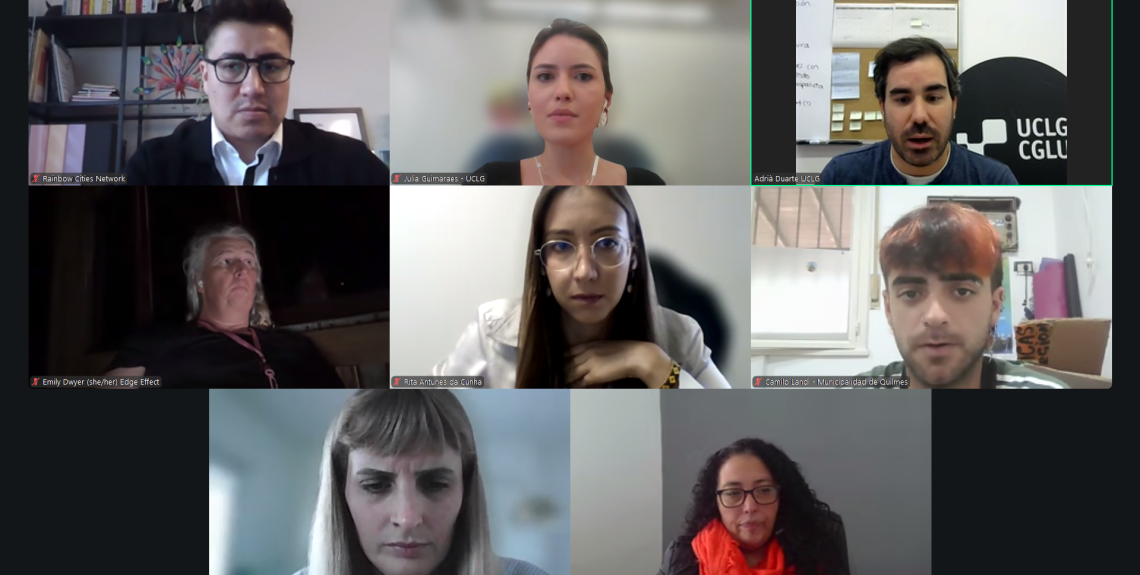
On 16 October, our Committee had the honor of participating in a powerful Expert Group Meeting on Human Rights Cities for All: LGBTIQ+ Inclusive Cities, co-organized by UN-Habitat, UCLG, the Office of the High Commissioner for Human Rights (OHCHR), ILGA World, Rainbow Cities Network, and the Geneva Human Rights Platform.
The meeting brought together over 50 participants to advance a crucial and timely dialogue on how to strengthen LGBTIQ+ persons inclusion in cities —particularly in the lead-up to the World Urban Forum (WUF13) in Baku (May 2026) and the mid-term review of the New Urban Agenda.
The urgent need to advance rights for LGBTIQ+ persons at the local level
While much progress towards respect for, and the protection and fulfilment of, the rights of LGBTIQ+ persons has been made over the past decades, cities globally are still not universally safe and accessible for all.
Opening the session, Robert Lewis-Lettington, Senior Advisor on Land, Housing and Human Rights at UN-Habitat, reminded participants that the exclusion of LGBTIQ+ communities is not a marginal issue but a structural, rights-based challenge. He emphasized the essential role of local governments in upholding those rights, underlining that “inclusive cities are more stable, creative and prosperous.”
Anaclaudia Rossbach, UN-Habitat Executive Director, emphasized that the inclusion of LGBTIQ+ persons is a priority in the agency’s Strategic Plan for 2026-2029: “Inclusion is not just a principle, it is a priority. The housing crisis for LGBTIQ+ persons is urgent.”
This commitment was echoed by the Ambassador of Mexico in Kenya, Gisele Fernández, who reaffirmed that progress must be rooted in a rights-based approach: “There is no sustainable development without the recognition of human rights. Equality and freedom for LGBTIQ+ persons are indispensable for cities that embrace diversity and leave no one behind.”
Human rights defenders and local authorities: From testimony to action
The session gave space to voices that are at the frontline of action. Human rights defenders from Hong Kong and South Africa shared how the lack of legal recognition and discriminatory practices continue to limit trans persons’ access to public services, housing, and basic safety. Both emphasized the need for legal reforms, the collection of disaggregated data, and stronger policies to fight discrimination.
From Ljubljana, Simona Topolinjak presented the city’s work to shift public attitudes, including awareness campaigns and long-term partnerships with civil society. From São Paulo, Léo Áquila highlighted the city’s extensive network of LGBTI+ reference centers, mobile outreach units, and the TransCidadania program which supports education and employment for trans persons. Yet, she warned of conservative backlash: “Our politicians try to divide us. We must resist and build solidarity across identities.”
What makes a city inclusive for LGBTIQ+ persons?
In the second part of the meeting, two breakout sessions explored concrete tools and policy recommendations to build inclusive cities. Adrià Duarte, coordinator of UCLG-CISDPHR, moderated two group discussions, which sent a clear message: An inclusive city for LGBTIQ+ persons ensures safety, equal rights, access to services, and meaningful participation. Participants from Quilmes (Argentina) and San Antonio (Chile) emphasized the importance of including LGBTIQ+ persons in urban planning and collaborating with NGOs and community-based organizations to ensure decision-making is rooted in lived experiences. Transformative shifts toward inclusive cities can only happen through genuine cooperation.
Looking ahead: WUF13, the NUA review, and advancing LGBTIQ+ rights
The meeting concluded with a shared commitment to push for LGBTIQ+ rights at upcoming global forums—particularly the World Urban Forum (Baku, May 2026) and the mid-term review of the New Urban Agenda. As Hamza Berrouane (UN-Habitat) stated: “Local governments are frontline defenders of rights, and WUF must provide safe spaces for human rights dialogues.”
The meeting called for:
-
Ensuring inclusive public spaces and access to housing and services for all LGBTIQ+ persons are high on the global urban agenda
-
Strengthening cooperation between local governments and grassroots and community-based organisations
-
Mainstreaming intersectionality in advocacy efforts, bridging LGBTIQ+ inclusion with broader struggles, including poverty, informal settlements, and the rights of people with disabilities
-
Promoting evidence-based policies through disaggregated and safe data collection
UCLG-CISDPHR remains committed to supporting local governments that champion human rights-based approaches—fostering solidarity, peer learning, and concrete tools for advocacy, so that no one is left behind, and the rights of all LGBTIQ+ persons are fully respected and protected.
Let’s make inclusion the norm, not the exception. Let’s build cities where everyone belongs.