

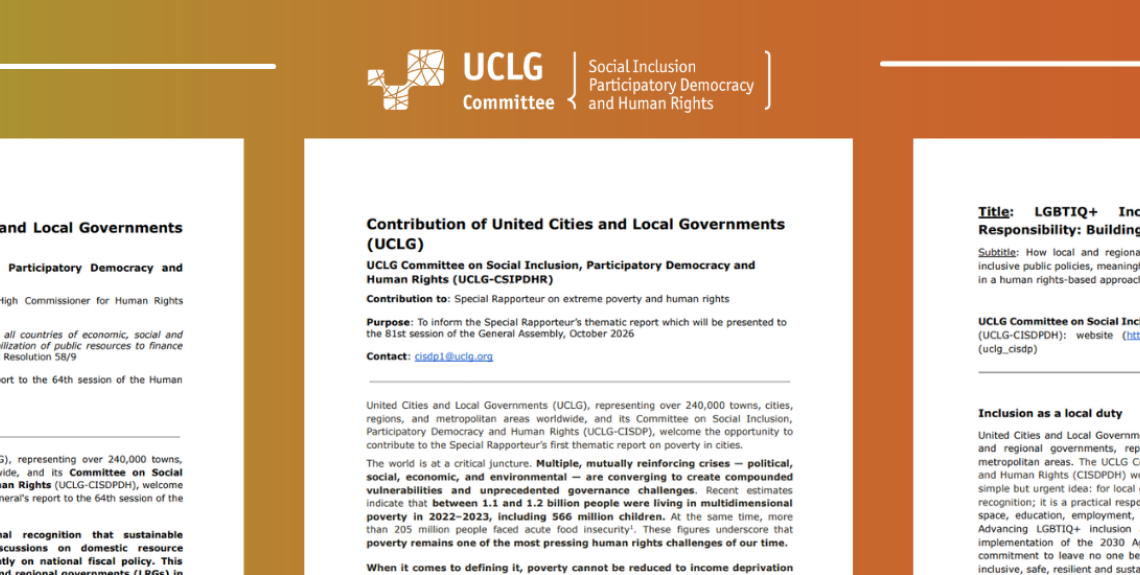
Between June and August 2026, our Committee submitted three contributions in response to calls from United Nations human rights mechanisms and partners, to inform their thematic reports and ongoing work.
The contributions addressed the role of local and regional governments (LRGs) in:
-
Poverty in Cities, for the Special Rapporteur on extreme poverty and human rights;
-
Advancing LGBTIQ+ inclusion at the local level, for the Local Pride, Global Impact Dossier, an initiative of Paradiplomacia.org;
-
Realizing economic, social and cultural rights, with a focus on the mobilization of public resources to finance sustainable development, in response to the Human Rights Council Resolution 58/9, for the Office of the High Commissioner on Human Rights (OHCHR).
All three contributions are anchored in the same vision: that LRGs are not mere implementers of decisions taken elsewhere, but duty-bearers responsible for organising the material conditions of dignity, equality, care, and participation in everyday life. This vision is carried forward through the Committee's Human Rights Cities agenda and its complementary instruments, namely the New Global Charter-Agenda for Human Rights in the City, adopted on 25 June 2026 at the UCLG World Congress in Tangier; the global campaign "10, 100, 1,000 Human Rights Cities and Territories by 2030"; and the Guidance Framework for creating a Human Rights City, developed together with OHCHR. Each contribution calls on the respective mechanism or actions to recognise LRGs as essential actors in realising rights at the local level, while pointing to the structural constraints they often face: limited mandates, insufficient financing, restricted fiscal autonomy, and exclusion from international decision-making.
Poverty in Cities — Special Rapporteur on extreme poverty and human rights
In its contribution to the Special Rapporteur's first thematic report on poverty in cities, to be presented to the 81st session of the General Assembly, our Committee affirmed that poverty is inherently multidimensional and cannot be reduced to income alone. Cities are often where inequalities are most visible, but also where transformative, rights-based action can be implemented most effectively — provided LRGs are empowered as human rights duty-bearers rather than mere providers of welfare.
The contribution presents the Human Rights Cities agenda as a practical framework for tackling the root causes of poverty and exclusion, illustrated by experiences from our network: Grigny's place-based anti-poverty strategy and Poverty Observatory (France), Johannesburg's Expanded Social Package (South Africa), the ville du quart d'heure in Paris (France), the Utopías initiative in Iztapalapa (Mexico City), energy communities in Getafe (Spain), and proactive municipal registration in Barcelona (Spain). It closes by calling for stronger multilevel governance — fiscal decentralisation, stronger mandates, disaggregated local data, and the recognition of people living in poverty as rights holders and partners.
Click here to read the full contribution
Advancing LGBTIQ+ inclusion at the local level — Paradiplomacia.org
Our Committee's contribution reframes LGBTIQ+ inclusion as a practical local responsibility tied to housing, public services, public space, education, employment, safety, culture, and participation — not a matter of symbolic recognition. It argues that cities become safer, fairer, and more democratic when they recognise LGBTIQ+ people as full rights holders, and that protecting these rights is a core requirement of equality, public health, and equal treatment under the law rather than a question of political "progressiveness."
Drawing on the Committee's participation in expert dialogues with UN-Habitat, the OHCHR, ILGA World, and the Rainbow Cities Network, the contribution stresses the value of peer learning and decentralised city-to-city cooperation, especially where national frameworks are incomplete or subject to backlash. It highlights the importance of embedding inclusion in institutions — regulations, budget lines, service standards, staff training, and accountability mechanisms — and of treating LGBTIQ+ people as partners in shaping policy, given how often exclusion intersects with poverty, migration status, disability, age, and race.
Click here to read the full contribution
Realizing economic, social and cultural rights, with a focus on the mobilization of public resources to finance sustainable development — Office of the High Commissioner on Human Rights (OHCHR)
In response to the call on the mobilisation of public resources to finance sustainable development requested by the Human Rights Council resolution 58/9, our Committee contributed to the Secretary-General's report to the 64th session of the Human Rights Council. The contribution argues that debates on domestic resource mobilisation continue to focus predominantly on national fiscal policy, overlooking LRGs — which, according to UN-Habitat, account for around 40% of public investment worldwide while receiving less than 10% of total public revenues.
Using the New Global Charter-Agenda as a lens, the contribution shows how public finance can advance economic, social and cultural rights at the territorial level, illustrated by cities in our network: property tax reform in Freetown (Sierra Leone), land value capture in São Paulo (Brazil), gender budgeting in Vienna (Austria), participatory budgeting in Porto Alegre (Brazil) Decidim in Barcelona (Spain), and the People's Plan Campaign in Kerala (India). Building on the Charter-Agenda's Right to Financing and Autonomy, it calls for aligning mandates with resources, fair local revenue mobilisation, protection of local social spending against austerity, direct LRG access to international finance, and participation and accountability as standard budgetary practice.
Click here to read the full contribution
Taken together, these three contributions carry a single message: whether the challenge is poverty, exclusion, or the financing of rights, its resolution depends on empowering the level of government closest to people's lives. By grounding each submission in the New Global Charter-Agenda for Human Rights in the City, our Committee reaffirms that human rights are universal in foundation but local in their realisation — and that local and regional governments must be recognised, resourced, and trusted as duty-bearers if that promise is to be kept. Through these contributions, the Committee continues to bring the voice of the municipal movement to the international arena, and to build, city by city, the societies grounded in rights that the Charter-Agenda envisions.