

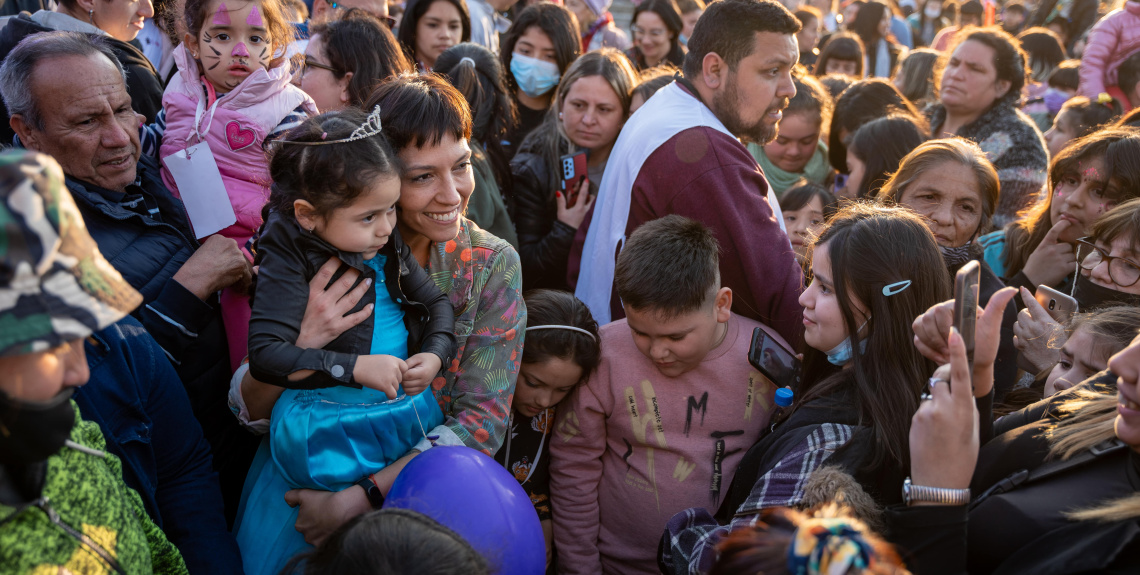
In December 2019, we began the local administration led by Mayor Mayra Mendoza – the first woman elected mayor in Quilmes' 365-year history – with the challenge of building a modern, inclusive, sustainable, and productive local government.
In this context, the more than 30 commitments made by the local government have an integral and cross-cutting approach to the fulfillment of Human Rights.
Within this framework, the administration aims to:
-
Consolidate local democracy through active citizen participation via the so-called Local Management Forums – which are organized periodically – and the construction of an open and transparent administration focused on the 30 commitments, which are specific projects whose progress is regularly reported.
-
Promote comprehensive development through a government program aimed at achieving significant progress in the Sustainable Development Goals, particularly in promoting Gender Equality (SDG 5) and building a Sustainable City (SDG 11), attentive to climate change and environmental care. To this end, the “Municipal Plan for Gender Equality” has been implemented, consisting of 19 measures that aim to strengthen a feminist perspective in our municipality, and the “Quilmes Clean” program and the creation of the “Quilmes Eco-park,” which seek to overcome the city's environmental backlog.
-
An inclusive approach, from the periphery to the center, beginning in the most marginalized neighborhoods and sectors of our city to reach everyone. In this sense, we have, for the first time, created a Migrant Affairs division within the local government, with specific policies for this population, which represents about 10% of our city's total population.
Local governments are the first point of contact for citizens’ demands. In this regard, we are convinced that, in complex contexts such as those faced in the urban peripheries of the Global South, it is possible to build administrations aimed at ensuring social well-being through a present state that recognizes and responds to the population's needs.
The recognition and fulfillment of Human Rights are possible through the implementation of regulations, actions, and public policy programs that are fundamentally based on guaranteeing access to rights such as health, education, culture, affordable housing, and social protection for all citizens – starting with the most marginalized and vulnerable to current crises – until equity and social justice indicators for the general population are improved. In short, the local government must work transversally across all areas to promote the development of a full life for all its inhabitants, contributing to the sustainable growth of cities.
According to World Bank estimates based on current trends, by 2050 the urban population is expected to double, and nearly 7 out of 10 people are projected to live in cities. Likewise, it is estimated that more than 80% of the world’s gross domestic product (GDP) is generated in urban areas.
In this context, cooperation among cities becomes necessary to seek solutions to the major challenges of today and the future. It also commits us to work collectively toward resilient reconstruction, where local governments play a key role.
In this framework, from the city of Quilmes, we commit to participate in and support the Cities of Rights campaign, as our government seeks to consolidate a global outlook that promotes access to rights and quality services through concrete actions, with the aim of guaranteeing a full life for our citizens.
-
The local government aims to consolidate a feminist municipality by developing public policies with a gender perspective. Within this framework, the Secretariat for Women and Diversities was established, an agency that develops the Municipal Plan for Gender Equality, which consists of 19 actions and programs aimed at reducing the gender gap and enhancing the economic, physical, and social autonomy of women and diversities.
-
Creation of the Secretariat for Environment and Sustainable Development. A central initiative is the upcoming opening of the Socio-environmental Complex Eco-park, which will provide efficient waste collection solutions. In addition, among many other initiatives, the "RECREO in my school" program is being carried out to promote environmental education in the district's schools.
-
For the first time in the history of the local government, the Directorate of Migrants was inaugurated with the objective of implementing public policies aimed at the migrant, refugee, and collective populations, with a comprehensive human rights approach.