

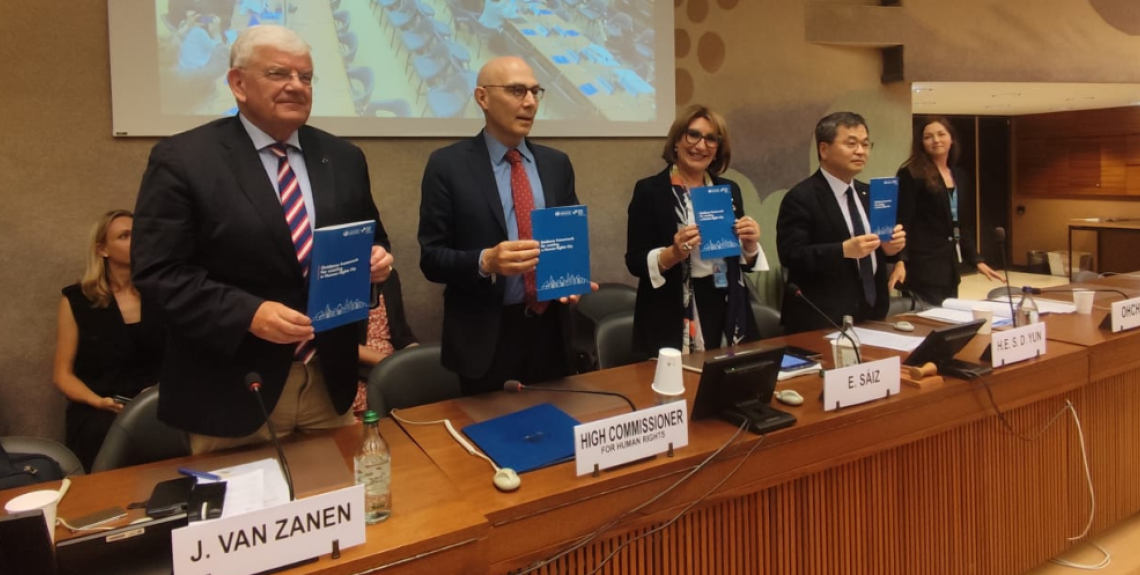
On 22 July, more than 50 representatives of local and regional governments, civil society organisations, academics, and United Nations human rights mechanisms gathered at the Office of the High Commissioner for Human Rights (OHCHR) in Geneva. This high-level dialogue reaffirmed a fundamental principle: true protection of human rights starts at the local level.
In his introductory remarks, the United Nations High Commissioner for Human Rights, Volker Türk, highlighted the transformative role of local and regional governments in building “an alternative to politics, an opportunity for inclusion, diversity, multiculturalism, and a future for the politics of kindness.”
A major milestone: presentation of the Guidance Framework for Creating a Human Rights City
At the heart of the event was the presentation of the Guidance Framework for Creating a Human Rights City, a political and technical document co-developed with the Office of the United Nations High Commissioner for Human Rights (OHCHR) and consolidated from the experience of pioneering local governments in human rights.
This framework identifies the key pillars for anchoring human rights in local policy:
-
Political and legal foundations
-
Institutional structures
-
Operational tools
As UCLG Secretary General Emilia Saiz noted:
“This framework provides the steps and tools to make human rights a reality in our cities.”
Access the Guidance Framework here
Local governments as guarantors and pioneers of rights
From The Hague, Barcelona, Santa Fe, Winnipeg, Gdansk, Quilmes, Rosario, Grigny, Banjul, and São Paulo, local leaders shared how they are pioneering public policies on human rights. Their interventions demonstrated that cities not only act as guarantors of the universal framework, but are also building a new generation of rights, placing care, local democracy, and anti-racism at the center. These elements are articulated around a renewed provision of public services, driven by the municipalist movement represented by UCLG.
Placing care at the center of human rights policies
Care policies and the gender perspective were central to the debate. The leadership of our co-presidency Seine-Saint-Denis was highlighted, with the first Observatory on Violence Against Women in France, which, based on international cooperation and solidarity, now inspires similar experiences in Palestine and Cameroon. From Quilmes, Gdansk, Rosario, Barcelona, and São Paulo, local policies on equality, combating gender-based violence, assistance to migrants, and promotion of LGBTIQA+ rights were shared.
A shared vision was reaffirmed: an economy that values care and measures growth by people’s well-being, not by GDP.
Policies to promote anti-racism
Delegations from cities such as New York and São Paulo shared strategies to combat structural racism at the local level:
-
Educational campaigns
-
Anti-discrimination bodies
-
Equitable access to employment (such as the 20% quota for Black people in São Paulo)
Local democracy and citizen participation
The strengthening of local democracy was another focus of the dialogue. Experiences were shared on territorial decentralization (Santa Fe), participatory models (Gdansk), and the importance of recognizing the role of active communities in the defense of rights.
Rights-based economy and responsible public procurement
The event showcased the transformative potential of public procurement for human rights. Barcelona and Utrecht showed how they apply human rights criteria in their procurement processes, even internationally. Both cities cut ties with companies involved in rights violations and promote a social economy with dignity and justice at its core.
From Winnipeg, the importance of integrating indigenous communities into the local economy and developing fair and sustainable procurement mechanisms was emphasized.
Comparative advantages of local governments in implementing human rights
During the event, the United Nations Special Rapporteur on extreme poverty and human rights, Olivier De Schutter, highlighted the elements that place local and regional governments in a strategic position not only to implement but also to innovate in the effective realization of human rights. Their proximity to citizens and their capacity for direct action make local governments key actors in promoting a renewed, human rights-centered provision of public services.
Among their comparative advantages, the following were highlighted:
-
Agility: Cities have a unique capacity to adapt and can respond more quickly than national levels, especially in crisis contexts.
-
Public participation: Local governments are better positioned to directly involve citizens in the design, implementation, and monitoring of public policies.
-
Coordination: The implementation of economic and social rights requires more effective intersectoral coordination, which is more achievable at the local level.
-
Experimentation: In some cities, such as in France, the right to experimentation is recognized in local legislation, allowing new ways of guaranteeing rights to be tested.
For these reasons, local governments are at the forefront of democratic and social innovation, making human rights a concrete reality for all people.
Common challenges: financing, powers, and multilevel cooperation
Several leaders agreed that without adequate powers and sufficient financing, rights cannot be guaranteed. Fiscal autonomy, joint work between levels of government, and support from international organizations were identified as key conditions for progress.
From SALGA, the need to support local authorities in training and coordination processes was reinforced. The need to create accreditation and recognition mechanisms for Human Rights Cities was also raised, to provide legitimacy and visibility to this model of governance.
A political call for boldness, cooperation, and collective action
The event closed with a powerful call from our co-president Philippe Rio, Mayor of Grigny:
“The path toward renewed and inclusive multilateralism requires even more boldness, cooperation, and resilience.”
Join our global campaign: “10, 100, 1,000 Human Rights Cities and Territories by 2030”
This meeting marks a new step in consolidating the global movement of Human Rights Cities and Territories. We invite more local governments to join the campaign and work together for a more inclusive multilateralism, from the local to the global.
If you are interested in joining the campaign, please contact the CSIPDHR Executive Secretariat at: [email protected]
Preparatory meeting of the global movement of Human Rights Cities
The event was preceded by a preparatory meeting with more than 20 key actors from the global movement of Human Rights Cities, held on 21 July at the Palais des Nations, headquarters of OHCHR.
From our Gwangju co-presidency, represented by Prof. Gyonggu Shin, to representatives such as Marta Siciarek (Association of Polish Cities), Shams Asadi (Director of the Vienna Office for Human Rights) and Morten Kjaerum (Raoul Wallenberg Institute), participants shared good practices for the local implementation of human rights.
The meeting also identified common challenges and opened new avenues for collaboration. A highlight was the possibility of continuing this dialogue within the framework of the next Gwangju Human Rights Cities Forum, scheduled for 2026.
“From local realities to global responsibility: involving local and regional governments in reporting and implementing human rights”
This was the title of the workshop held on July 23 in Geneva, which explored how National Mechanisms for Implementation, Reporting, and Follow-up (NMIRF) can act as bridges between international human rights standards and local realities.
The session brought together more than 100 participants—including representatives of local and regional governments, city networks, civil society, independent experts, and United Nations agencies—to discuss how to include LRGs in human rights monitoring.
Experiences from more than 40 countries were shared, highlighting that recognizing local governments as co-owners of the monitoring cycle is not only a matter of justice but also of institutional effectiveness.
Read the summary of the meeting at this link (available in English).